












The year we started shipping AI agents at scale


For a long time, “AI” inside most companies looks like experimentation.
You test a few use cases. You run demos. You prove that the technology can work.
Somewhere in the middle of 2025, that changed for us.
The conversations stopped being about whether AI could handle real customer interactions and started being about how to run it reliably, at scale, across voice and messaging, without breaking trust, workflows, or customer experience along the way.
That shift came from hundreds thousands of real conversations and what we learned once those conversations moved into production.
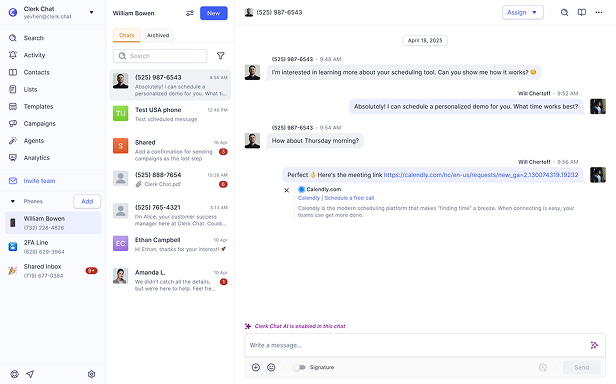
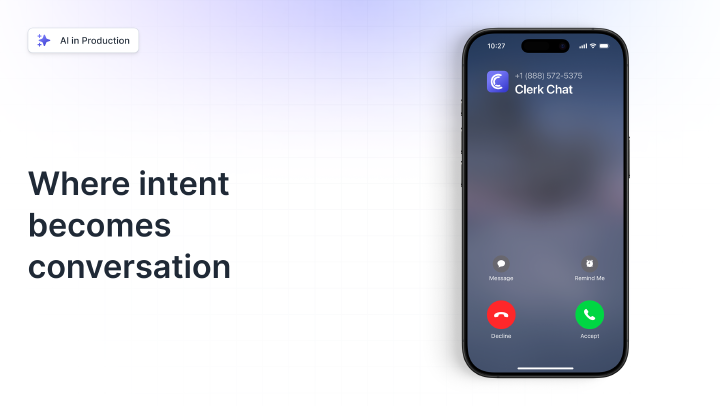
What started as early work and experimentation on FAQs and follow-ups evolved into production of voice-first AI agents handling hundreds of conversations a day across industries like financial services, home services, and franchised retail.
By the end of the year, we were asking what happens when this runs all day, every day?
That’s the difference between simply experimenting with AI and actually shipping it.
From use cases to systems
Early on, most of our AI work looked familiar.
Answer common questions. Update a CRM. Send follow-ups.
Those use cases mattered (and still do) but the bigger challenge was everything around them: memory, integrations, testing, latency, compliance, and the operational reality of running AI in production. The moment AI starts talking to real customers, especially over voice, the bar changes.
It’s no longer enough for an agent to sound good in a demo. It has to:
- Handle interruptions and edge cases
- Maintain context across conversations (and across mediums)
- Integrate cleanly with the systems teams already rely on
- Recover gracefully when something goes wrong
In other words, the work shifted from what can AI do? to what does it take to support AI at scale?
Voice was the signal
At the start of the year, most of our assumptions were messaging-first.
We were building SMS and RCS agents for support, follow-ups, and campaigns. Voice existed, but it wasn’t the center of the story yet.
Then customer conversations started telling us something different.
Demo after demo, voice generated more excitement. Customers asked harder questions. Deals moved faster. The stakes were clearer, and so was the value.
By mid-year, it became impossible to ignore. Voice wasn’t just another channel; it was where customers felt the impact most directly. Where wait times, deflections, missed calls, and staffing constraints showed up immediately.
By the end of the year, voice AI wasn’t an experiment or an add-on. It was the primary driver behind our largest and most complex implementations, including an enterprise deployment projected to handle millions of minutes of AI-driven conversations.
Built with customers, not in isolation
One of the clearest patterns that emerged in 2025 was how tightly product development and customer delivery became linked.
Nearly every major customer pushed the platform forward in some way:
- A franchise model reinforced clear feedback loops and the importance of becoming part of the business workflow, to build an AI agent that performs this workflow.
- A university environment raised the bar for knowledge base accuracy at scale.
- An enterprise deployment exposed the limits of concurrency, testing, and reliability.
Over time, a pattern emerged: build for one, then productize for many.
Capabilities that started as customer-specific solutions, voicemail detection, warm transfers, advanced CRM syncing, memory improvements, became reusable building blocks across the platform.
This approach kept us from becoming a pure services organization while still allowing us to move fast and solve real problems. It also meant that every new deployment made the platform stronger for the next one.
The hard lessons that only show up in production
Running AI in production has a way of surfacing bugs, which never felt to us like a brick wall but rather, a problem to solve.
We learned that:
- Many customers get stuck in “testing mode” unless launch expectations are clear
- Integrations create massive value and massive complexity
- Voice introduces challenges text never will: latency, audio quality, interruptions, provider reliability
- Knowledge bases don’t magically work just because documents exist
The biggest realization was this: the most successful deployments weren’t the ones that waited for 100% accuracy. They were the ones that launched, learned, and improved in production.
AI doesn’t get better in isolation. It gets better in the real world.
What changed by the end of the year
By December (less than a month ago at publish time), the work looked very different than it did in January 2025.
AI agents weren’t just responding to messages. They were:
- Handling live voice conversations with real customers
- Maintaining memory across interactions
- Orchestrating workflows across voice and messaging
- Integrating deeply with CRMs and operational systems
- Improving over time based on real conversation data
The team had shifted from experimenting to operating. From demos to durability. From “can this work?” to “how do we scale this without breaking trust?”
That shift is subtle from the outside, but it changes everything about how you build, test, and support AI.
Looking ahead
Now, in 2026, we’re focused on what it takes to run AI well - operating reliably, at scale, and across voice and messaging.
Our transition from simply experimentation to productization was shaped by real customers and real conversations.
As we continue building and learning, we’ll keep sharing perspectives from the process and best practices from our customers’ implementations, all while staying focused on what it actually takes to ship AI that holds up in the real world.
And we hope you’ll join us for the stories.
 William Bowen
AI Specialist
William Bowen
AI SpecialistWill’s latest superpower is building innovative AI solutions to add value for clients. He's passionate about all things AI, entrepreneurship, and enjoys staying active with sports and outdoor activities.
#Subscribe
Get product updates in your inbox
Tutorials, features, and Clerk Chat news delivered straight to you.