











Teams Phone Agent: Microsoft's AI Receptionist, Licensing, and Native Limits


Teams Phone Agent is now generally available. On September 30, 2026, Microsoft announced on the Teams blog that its AI calling receptionist for Teams Phone began rolling out to GA, after entering Frontier public preview on June 15, 2026. Callers can say what they need instead of pressing through a keypad menu, and the agent answers questions, books appointments, and routes calls with AI-generated notes.
That is a real upgrade for voice. It is also a voice-only one. Teams Phone Agent is reached through a resource account, and Microsoft still marks resource account numbers as not available for native texting. If you were hoping the new receptionist would also cover microsoft teams sms on your main line, it does not.
This guide covers what Teams Phone Agent does at GA, what stays in preview, how licensing and Copilot Credits work, how setup fits next to auto attendants and call queues, and the native limits that still need a plan.
In this article:
What Teams Phone Agent Is
Teams Phone Agent is a conversational AI receptionist built on top of the Teams Phone auto attendant. In the Teams admin center you create one under Voice > Auto attendants > Add > Teams Phone Agent. Microsoft’s setup guide notes that turning the Teams Phone Agent toggle off returns you to the standard auto attendant options, so it is best understood as an AI layer on the attendant you already know.
Microsoft lists these capabilities as generally available:
- Answer questions. Callers get conversational answers about hours, locations, policies, or service details, grounded in FAQ files and URLs you configure. Microsoft says Questions and Answers URLs are refreshed daily.
- Appointment self-service. Callers can set up, reschedule, cancel, or review appointments through integrations you configure. A Microsoft Bookings integration was added on September 1, 2026.
- Route with context. The agent identifies the right person or department, transfers the caller, and gives the recipient AI-generated conversation notes.
- More than 60 languages and locales. You set a default language for the disclaimer and fallback, and the agent can converse in the caller’s language where supported.
- After-hours coverage. Separate business-hours, after-hours, and holiday call flows, the same model auto attendants use.
Admin controls that shipped along the way include spam detection (the agent disconnects calls it determines are spam unless a Spam Detection template says otherwise), a customizable AI disclaimer, Automatic Recording templates, historical reporting, and a maximum call length. The default call length is 4 minutes, after which callers hear a disconnect message and the call ends.
What Is GA and What Is Still Preview
Microsoft is careful to separate three things in the September 30 announcement:
| Capability | Status as of October 6, 2026 |
|---|---|
| Built-in Teams Phone Agent receptionist (Q&A, appointments, routing with notes, languages, after hours) | Generally available, rolling out |
| Teams Phone Agent metrics in the Queues app supervisor dashboard | Public preview (Queues app requires Teams Premium) |
| Custom Copilot Studio voice agents, via handoff from Teams Phone Agent or direct dial on a resource account | Frontier preview |
The Copilot Studio integration has its own gate. Microsoft’s Copilot Studio integration doc says tenants must be explicitly enabled by Microsoft support before the Teams Phone Agent channel appears, and you need a Copilot Studio tenant license plus user licenses for makers. Plan your rollout on the GA receptionist and treat custom voice agents as a pilot.
Licensing, Copilot Credits, and Resource Accounts
Microsoft’s prerequisites and licensing reference lists the base requirements for Teams Phone Agent:
- At least one Teams Phone license in the tenant.
- A free Microsoft Teams Phone Resource Account license for each resource account.
- Copilot Credits and a spending policy.
The Teams blog says Teams Phone Agent is billed with usage-based Copilot Credits, and consumption varies with call duration and the capabilities invoked during a call. Microsoft points to its Copilot Credits guidance for estimates and does not publish a flat per-call price in the announcement. Add-ons stack on top: Bookings for appointments, Power Automate for flows, Copilot Studio and its own consumption billing for custom voice agents, and Teams Premium for anyone who needs the Queues app.
Two resource account rules matter more than they look:
- Callers reach the agent through a resource account. The setup guide says the “through a voice app (no resource account needed)” option is not currently available for Teams Phone Agent. If external callers dial it, that resource account needs a phone number. Microsoft allows a Calling Plan service number, an Operator Connect number, a Direct Routing number, or a hybrid number, including toll or toll-free.
- Outbound PSTN from the agent costs extra. If the agent transfers callers to an external phone number, the resource account needs more than the free license. For Microsoft-provided numbers that means a funded pay-as-you-go license or Communications Credits (or telco pay-as-you-go overage in New Commerce). Direct Routing needs an online voice routing policy. Operator Connect numbers have no extra Microsoft requirement, though Microsoft told OC customers in MC1123837 to confirm on-behalf-of outbound scenarios with their carrier after the November 1, 2025 change.
Resource accounts are disabled for sign-in, and Microsoft states that chat and presence are not available on them. That last line is the root of the texting gap below.
How Teams Phone Agent Fits With Auto Attendants and Call Queues
Teams Phone Agent does not replace the rest of the voice stack. It routes into it. In the business-hours or after-hours call flow, choosing Play menu options engages the agent, and its destinations can be an operator, a voice-enabled person, Questions and Answers or Appointments tools, Copilot Studio agents and third-party IVRs, another Teams Phone Agent, an auto attendant or call queue, a resource account, a Microsoft 365 group voicemail, or an external number.
A few setup details from Microsoft’s known issues and option list are worth reading before go-live:
- Use resource account transfers for Teams Phone Agent to Teams Phone Agent, auto attendant to Teams Phone Agent, and call queue to Teams Phone Agent. Voice app based transfers are not supported for those paths.
- Audio file greetings and announcements are not supported. Greetings are typed text, which the agent can speak in multiple languages.
- Assigning an Automatic Recording template during creation fails. Save the agent first, then edit it to add the template.
- Trunk transfers still do not cross PSTN paths. Microsoft’s reference says transfers between Calling Plan, Operator Connect, and Direct Routing trunks are not supported, so keep the agent, queues, and external transfer targets on a path that works together.
- Not supported in India. Microsoft lists India as unsupported for Teams Phone Agent.
If you already run a menu attendant, the practical migration is to recreate the main line as a Teams Phone Agent with the same hours and holidays, keep your queues as destinations, and keep a keypad operator option for callers who want a person.

The Native Limit: The AI Receptionist Number Still Cannot Text
Teams Phone Agent answers the phone. It does not give that phone number a text channel.
Native SMS in Teams is only available on Calling Plan phone numbers in the United States (including Puerto Rico) and Canada, after Brand and Campaign approval. Microsoft’s SMS management article says SMS status shows Not available when a number is assigned to a resource account. Teams Phone Agent requires a resource account to take direct calls. So the published number your AI receptionist answers is, by Microsoft’s own rules, outside native texting. That is true whether the number came from a Calling Plan, Operator Connect, or Direct Routing.
Even on numbers that can text, the native product is narrow: 1:1 chat on a user-assigned number, plain SMS only, no MMS or group threads, and 10-digit long code senders only. We cover those caps in native Teams SMS limits.
In practice this shows up in three places:
- Appointment confirmations. The agent can book in Bookings during the call, but the main number cannot send the customer a confirmation text from the same line.
- After-hours follow-up. A caller who reaches the 4-minute default limit hears the disconnect message and the call ends. There is no native way to text them from the number they called.
- Customers who text the main line. People text the number on your website and Google listing. A resource account number has no native inbox for those replies, AI or human.
When to Add a Messaging Layer Next to Teams Phone Agent
Use Teams Phone Agent on its own when:
- Your goal is voice self-service and smarter routing on an existing Teams Phone main line.
- Copilot Credits usage, Teams Premium for supervisors, and resource account licensing fit your budget.
- Callers do not expect to text the main number, and follow-up can happen by phone or email.
Add a Teams messaging layer when:
- The published number needs to send and receive SMS or MMS, not just answer calls.
- You want a text follow-up after the call, using what the caller asked for.
- More than one coordinator needs to see and reply in the same customer thread.
- Your numbers sit on Operator Connect or Direct Routing, where native Enable SMS was never an option.
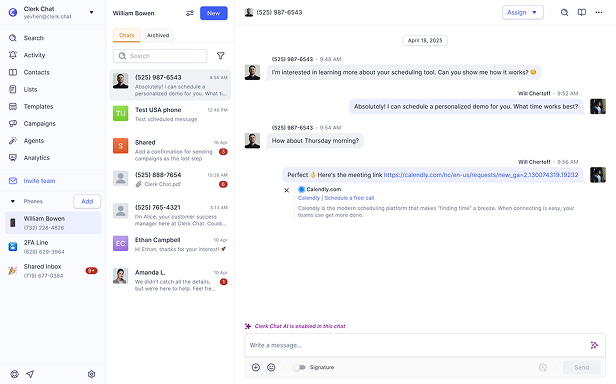
Clerk Chat runs inside Teams beside Teams Phone and adds SMS and MMS on your Teams numbers, including resource account, Operator Connect, and Direct Routing numbers native SMS does not cover, with a shared inbox for the team. If you want AI on both channels, our AI agents for Teams Phone answer calls and send voice-to-SMS follow-ups on the same Teams numbers. You can keep Microsoft’s receptionist for voice and still close the texting gap.
Frequently Asked Questions
What is Teams Phone Agent?
Teams Phone Agent is Microsoft’s AI calling receptionist for Teams Phone. It answers incoming calls on a service line, responds to questions grounded in FAQ files and URLs, handles appointment self-service, and routes callers to the right person or department with AI-generated notes. Admins create it in the Teams admin center from the auto attendant setup flow.
When did Teams Phone Agent become generally available?
Microsoft announced that Teams Phone Agent began rolling out to general availability on September 30, 2026. It entered Frontier public preview on June 15, 2026. The Queues app dashboard integration remains in public preview, and Copilot Studio custom voice agents remain in Frontier preview.
How is Teams Phone Agent licensed?
The tenant needs at least one Teams Phone license, each resource account needs a free Microsoft Teams Phone Resource Account license, and usage is billed through Copilot Credits with a spending policy in place. Bookings, Power Automate, Copilot Studio, and Teams Premium for the Queues app are separate.
Does Teams Phone Agent need a resource account?
Yes, for callers who dial it directly. Microsoft says reaching a Teams Phone Agent through a voice app without a resource account is not currently available. External callers need a phone number on that resource account, which can be a Calling Plan, Operator Connect, Direct Routing, or hybrid number.
Can Teams Phone Agent send text messages?
Microsoft does not list SMS among Teams Phone Agent capabilities, and the number it answers on is a resource account number. Microsoft marks SMS as Not available for numbers assigned to a resource account, so the agent’s published number cannot use native Teams SMS.
Does Teams Phone Agent replace auto attendants and call queues?
No. It is built on the auto attendant experience and routes into existing auto attendants, call queues, people, voicemail, and external numbers. Call queues still handle hold and distribution to agents, and the keypad operator option is still recommended.
How many languages does Teams Phone Agent support?
Microsoft says Teams Phone Agent supports natural conversations in more than 60 languages and locales. Admins set a default language that the agent uses for the disclaimer and when it cannot match the caller’s language.
The Bottom Line
Teams Phone Agent is one of the most significant changes to Teams Phone call flows this year. As the September 30, 2026 rollout reaches tenants, Teams Phone customers can put a conversational receptionist on a main line, with Q&A, Bookings appointments, contextual transfers, more than 60 languages, and after-hours coverage, billed on Copilot Credits. Custom Copilot Studio voice agents and the Queues app dashboard are still preview.
The limit is the same one that applies to auto attendants and call queues. The AI receptionist lives on a resource account, and resource account numbers cannot use native Teams SMS. If your customers expect to text the number they call, plan a messaging layer next to the agent. See the Microsoft Teams integration or book a demo and we will map which of your Teams numbers answer with AI, which need to text, and where native Teams Phone stops.
#Subscribe
Get product updates in your inbox
Tutorials, features, and Clerk Chat news delivered straight to you.